Office Janitorial & Indoor Air Quality: A Smarter Partnership
Office janitorial and HVAC filtration aren't separate concerns—they're a shared IAQ system. Here's how LA County businesses can use cleaning strategy to protect indoor air quality and occupant health.
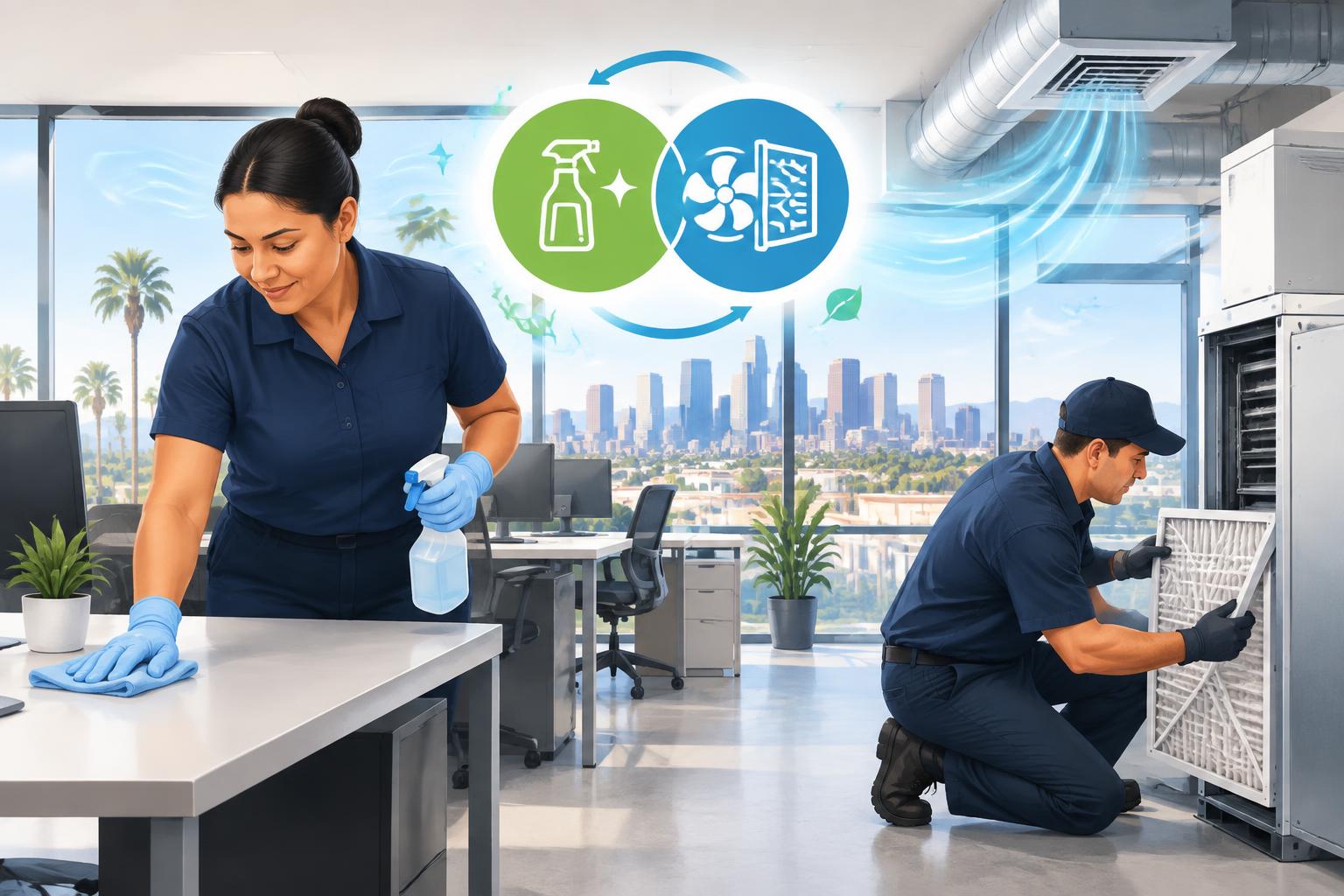
The Hidden Air Problem Most LA County Offices Don't See Coming
Walk into most offices in LA County and you'll notice whether the floors are clean or the trash has been emptied. What you won't notice—but your lungs will—is the accumulated dust, allergens, and particulate matter circulating silently through the space. Office air quality doesn't announce itself until employees start complaining of headaches, fatigue, or recurring respiratory irritation.
The U.S. EPA's Office Building Occupant's Guide to Indoor Air Quality makes this plain: indoor air quality is a shared responsibility, shaped by how well pollutant sources are managed, how ventilation systems are maintained, and how consistently good hygiene practices are upheld throughout the building. Janitorial services are not a peripheral concern here—they are a front-line intervention.
For businesses in the LA County area, where wildfire smoke, urban particulate pollution, and year-round occupancy compress the stakes, getting this partnership right matters more than in most markets.
Why Janitorial Work Directly Affects What Your HVAC System Breathes
Most facility managers think of HVAC and janitorial as separate line items. In practice, they are tightly coupled. Dust that accumulates on surfaces, in corners, and under furniture eventually becomes airborne—and airborne particles are exactly what your filtration system has to capture. The dirtier the surfaces, the harder the filters work. The less frequently they're changed, the more particulate recirculates.
The CDC's guidance on improving air cleanliness recommends upgrading central HVAC filters to MERV-13 or better and ensuring that filter housings are properly sealed so air moves through the filter rather than around it. But that filtration upgrade only reaches its potential when the underlying source load—the settled dust, debris, and biological material on surfaces—is being systematically reduced.
Think of it this way: filtration manages what's already airborne. Commercial cleaning reduces what becomes airborne in the first place. The two strategies reinforce each other, and neither is sufficient alone.
The Specific Tasks That Close the Gap
Consistent office cleaning in the LA County area should address more than visible surfaces. High-impact IAQ tasks include:
- Vacuuming with HEPA-equipped equipment, which captures fine particles rather than redistributing them
- Damp wiping of horizontal surfaces, including shelves, windowsills, and equipment tops where dust settles fastest
- Cleaning and clearing air vents and grilles, which the EPA specifically flags as a common obstruction point
- Restroom and breakroom sanitation, which controls moisture-related contamination before it reaches HVAC airflow
These aren't extras—they're the mechanical inputs that determine whether your filtration investment performs as designed.
What a True IAQ Partnership Looks Like in Practice
Positioning janitorial services as an IAQ partner means coordinating cleaning scope and frequency with your building's ventilation reality. A few practical distinctions worth understanding:
Cleaning frequency tied to occupancy patterns. High-traffic zones—conference rooms, open workstations, entryways—accumulate particulate load faster. Scheduling more intensive attention in these areas, rather than applying a uniform standard across the building, reduces the peak airborne load that HVAC has to manage.
Product selection matters. Cleaning products that off-gas volatile organic compounds (VOCs) introduce new pollutants even as they remove others. Selecting low-VOC or certified cleaning chemistries keeps the intervention from creating a second problem. Organizations like Green Seal have developed standards specifically for cleaning products to help facility teams identify safer options.
Post-construction and post-renovation scenarios demand special attention. Construction dust—fine silica, drywall particulate, adhesive residues—is among the most damaging to both HVAC filters and occupant respiratory health. Professional post-construction cleaning in the LA County area is not cosmetic; it's a prerequisite for safely reoccupying any renovated or newly built commercial space.
Floor Care: The Overlooked IAQ Lever
Flooring is the largest surface area in any office—and the primary reservoir for settled particulate. Hard floors in high-traffic zones are routinely walked on and scuffed, resuspending dust with every step. Carpet holds particles but releases them under foot traffic if not maintained properly.
Systematic floor care in the LA County area that includes routine vacuuming, periodic extraction or deep scrubbing, and appropriate finish maintenance keeps this reservoir from overwhelming the air. This is especially relevant in older commercial buildings common across LA County, where older carpet or porous grout can harbor contaminants that surface cleaning alone won't address.
Decisions about stripping, refinishing, or replacing floor finishes should also account for the chemical load introduced. The ISSA has noted that the global cleaning services market is increasingly shaped by sustainability priorities—product choices that reduce chemical off-gassing align both with IAQ goals and with broader organizational commitments to healthier work environments.
Choosing the Right Janitorial Partner for IAQ Goals
Not every cleaning provider approaches the work through an IAQ lens. When evaluating janitorial services in the LA County area, look for providers who can speak specifically to:
- The equipment they use and whether it includes HEPA filtration at the vacuum stage
- How they sequence tasks to avoid redistributing particulate (e.g., dusting before vacuuming, not after)
- Their approach to product selection and VOC reduction
- How they handle high-stakes scenarios like post-construction cleanup or deep cleaning after water intrusion events
The EPA's guidance emphasizes that building managers should maintain a working relationship with vendors on indoor environmental issues—not just assign tasks and walk away. A provider who understands IAQ as a framework, not just a checklist, is far more likely to deliver results that are actually measurable in occupant comfort and filter performance.
Ready to Treat Clean Air as a Business Priority?
If your LA County office building or commercial space is due for a cleaning partner who understands the connection between surface hygiene and air quality, reach out to LA Cleaning Solutions, LLC. Whether you need recurring commercial cleaning, a one-time deep clean, post-construction remediation, or floor care services, the team is available to assess your space and build a scope that supports both cleanliness and healthier indoor air. Contact LA Cleaning Solutions, LLC directly to schedule a walkthrough and consultation.
About this illustration
This editorial image was created with AI. It is not a photograph of an actual customer, property or completed service.