Office Cleaning & Indoor Air Quality: A Smarter Partnership
Office cleaning and HVAC filtration are more connected than most LA County facility managers realize. Learn how coordinating janitorial services with your ventilation system can deliver measurable ind
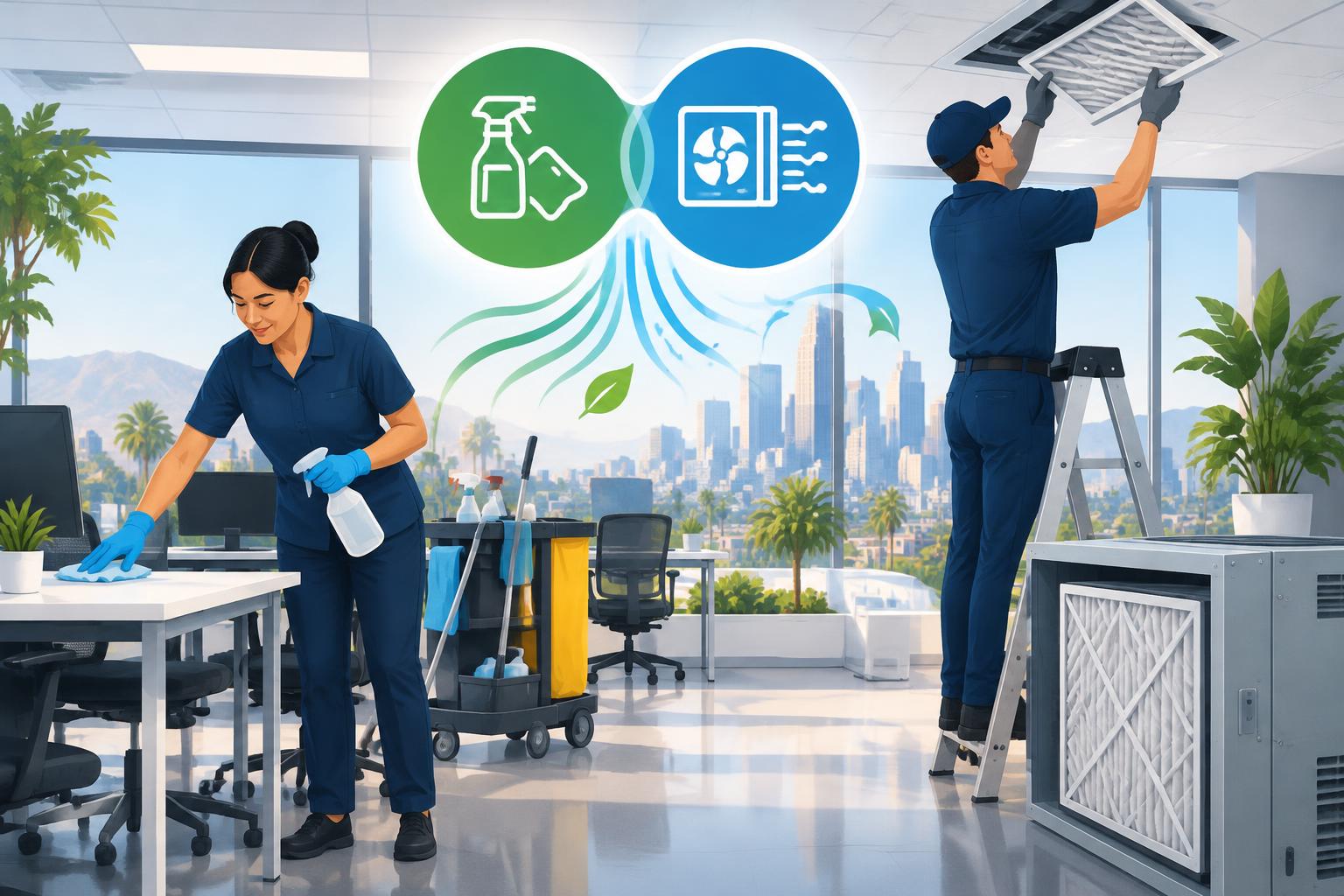
Office Cleaning & Indoor Air Quality: Why Janitorial Services and HVAC Filtration Work Better Together
Most LA County office managers think about cleaning and ventilation as two separate line items. One belongs to the facilities checklist; the other lives in the HVAC maintenance contract. But indoor air quality (IAQ) doesn't respect those organizational boundaries — and treating them as unrelated problems is one of the most common reasons office environments stay unhealthy even after a recent deep clean.
If your team has been dealing with persistent dust buildup, lingering odors, or unusually high rates of seasonal illness, the culprit may not be cleaning frequency alone. It's more likely a gap between what your janitorial service handles and what your ventilation system actually needs.
Why Surface Cleaning Alone Isn't Enough
Dust and Particulates Recirculate Through the Air
When cleaning crews dust surfaces, vacuum carpets, or mop floors, they dislodge particulates that don't simply disappear. Without adequate filtration, those particles re-enter the air column and resettle — or get pulled into return air vents and recirculated throughout the building.
This is why the sequence and method of cleaning matters as much as the cleaning itself. High-dust tasks performed without HEPA-rated vacuums or microfiber tools can temporarily worsen air quality before it improves. A well-coordinated approach between your office cleaning provider and your HVAC maintenance team can prevent that short-term spike from becoming a recurring problem.
The EPA's Multi-Layered Approach
According to updated EPA guidance on indoor air quality strategies, Americans spend approximately 90% of their time indoors, and a multi-layered approach — combining filtration improvements, ventilation adjustments, and air circulation — is recommended to protect occupants from airborne respiratory viruses and pollutants.
That guidance specifically identifies upgrading HVAC filters, using portable air cleaners, and running circulation fans as complementary strategies. None of those measures work optimally in a space where dust, dander, and debris are being consistently reintroduced through inadequate surface cleaning.
What a True IAQ Partnership Looks Like in Practice
Coordinating Cleaning Schedules with Filter Change Cycles
A practical starting point is aligning your janitorial service's deep-cleaning schedule with your HVAC filter replacement cycle. Hypothetically, scheduling a thorough office cleaning — including vent cover wiping, carpet vacuuming, and hard-floor dust mopping — within 24 to 48 hours before a planned filter change gives the new filter the cleanest possible environment to operate in from day one.
This kind of coordination doesn't require a formal contract between vendors. It simply requires that both parties know the other's schedule — something your facilities manager can coordinate with a brief monthly check-in.
Choosing Cleaning Products That Don't Undermine Air Quality
Conventional cleaning products can introduce volatile organic compounds (VOCs) into office air, which HVAC systems then spread throughout the space. Standards like the Green Seal GS-42 certification for commercial and institutional cleaning services exist precisely to address this — establishing criteria for cleaning product formulations, packaging, and procedures that reduce chemical exposure indoors.
When evaluating a commercial cleaning provider in LA County, it's worth asking whether they follow low-VOC or green-certified product protocols. This is especially relevant in shared office environments where occupants have varying sensitivities.
High-Impact Cleaning Zones for IAQ
Areas That Feed Directly into Air Circulation
Not all surfaces contribute equally to indoor air quality. The zones that most directly affect what your HVAC system picks up and redistributes include:
- Return air vent covers and grilles — dust accumulates here and gets pulled directly into the system
- Carpeted areas and soft furnishings — primary reservoirs for allergens, dander, and fine particulates
- Break rooms and kitchens — moisture and food residue create conditions for mold and bacteria
- Entry mats and high-traffic corridors — track-in soil from outside is a major source of indoor particulate load
Prioritizing these zones — rather than defaulting to a one-size-fits-all cleaning rotation — is where professional office cleaning in the LA County area can deliver measurable IAQ improvements, not just visual cleanliness.
Post-Construction and Move-In Scenarios Require Special Attention
Construction dust is a particularly aggressive IAQ challenge. Fine silica and drywall particles can infiltrate HVAC ductwork and remain there long after surfaces appear clean. Post-construction cleaning in the LA County area should always include duct inspection coordination and thorough HEPA vacuuming before a new tenant occupies a space. The same applies to move-in and move-out cleaning situations, where residual particulates from the previous occupant can affect air quality for an incoming tenant immediately upon move-in.
Practical Steps LA County Offices Can Take Now
Before making any vendor changes, start with an honest audit of your current situation:
- Check filter change logs. If HVAC filters are being changed on a fixed calendar schedule rather than based on actual load, you may be running dirty filters during your highest-occupancy periods.
- Ask your cleaning provider about their vacuuming equipment. Standard upright vacuums without HEPA filtration can exhaust fine particles back into the air.
- Map your cleaning schedule against your peak-occupancy hours. Cleaning during or immediately before high-occupancy periods increases the likelihood that disturbed particulates are inhaled by occupants.
- Request a walkthrough with both your janitorial and HVAC contacts present. Even a single joint visit can surface misalignments that neither vendor would catch on their own.
These steps don't require significant investment — they require coordination, which is often the missing ingredient in commercial building IAQ management.
Work with a Cleaning Partner Who Understands the Full Picture
Indoor air quality is a shared responsibility, but it starts with what happens on your floors, surfaces, and vents every week. If your current approach treats janitorial services as a standalone function disconnected from your building's air systems, you're leaving a significant portion of your IAQ potential on the table.
LA Cleaning Solutions, LLC serves commercial and residential clients throughout the LA County area with professional janitorial services, commercial cleaning, and specialty cleaning programs designed to support healthier indoor environments. Whether your facility needs routine office cleaning, post-construction cleanup, or a comprehensive deep cleaning assessment, their team is ready to discuss how cleaning practices can complement your existing ventilation and filtration setup.
Reach out to LA Cleaning Solutions, LLC directly to schedule a consultation or get a quote for your LA County facility. A cleaner building and cleaner air aren't competing goals — with the right partner, they're the same goal.
About this illustration
This editorial image was created with AI. It is not a photograph of an actual customer, property or completed service.