Office Cleaning as an IAQ Partnership in LA County
Office cleaning done wrong can worsen indoor air quality, not improve it. Learn how Green Seal–rated products and ventilation coordination create a genuine IAQ partnership for LA County businesses.
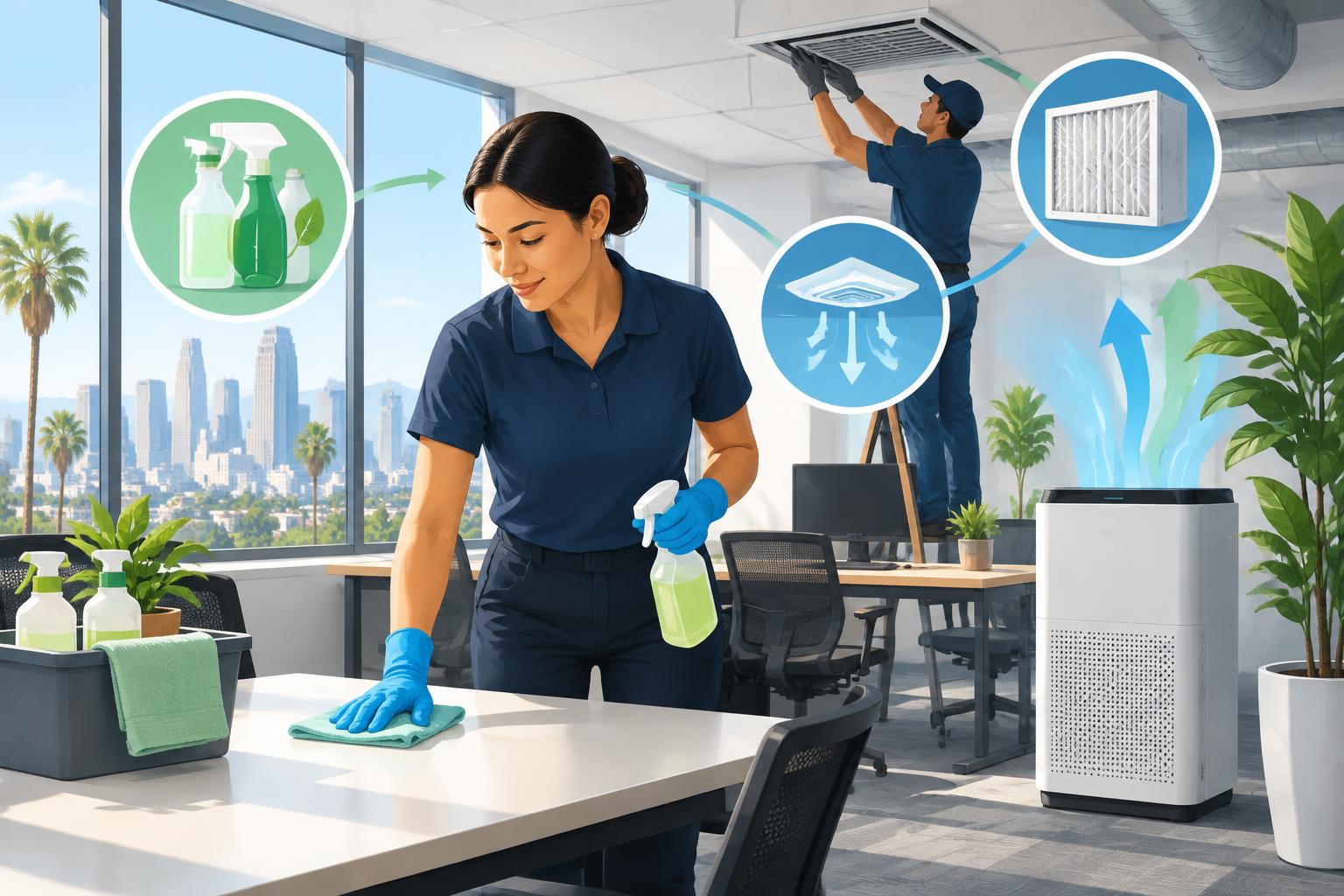
Office Cleaning as an Indoor Air Quality Partnership in LA County
Most office managers think about cleaning as a janitorial checklist—vacuumed floors, emptied bins, wiped desks. But if the products used to clean those surfaces are releasing volatile organic compounds (VOCs) into a poorly ventilated space, the result can be air that's measurably worse after the cleaning crew leaves than before they arrived. That's not a hypothetical concern; it's a documented gap between surface hygiene and genuine indoor air quality (IAQ).
For businesses across LA County, where commercial buildings often run HVAC systems under heavy load and windows stay closed for energy efficiency, this gap matters. A more deliberate approach—one that treats office cleaning in LA County as an IAQ partnership rather than a one-off service—can meaningfully change the air your employees breathe every day.
Why Surface Cleaning Alone Isn't Enough
The Chemical Tradeoff Most Cleaners Ignore
Conventional cleaning products can introduce VOCs, fragrances, and aerosol particulates that linger long after surfaces dry. In a sealed office environment, those compounds accumulate. The problem isn't visible, which is partly why it persists: a clean-looking desk and a healthy breathing environment are two different things.
Switching to products certified under standards like Green Seal's GS-37 for industrial and institutional cleaning products addresses this directly. GS-37 sets restrictions on harmful ingredients, VOC limits, and packaging requirements—criteria designed specifically for the commercial environments where cleaning happens most frequently and at the highest volume.
Surface Residue and Airborne Particles
Cleaning also disturbs settled dust, allergens, and microbial material. Without adequate air movement during and after cleaning, those particles simply resettle or remain suspended. The sequence and method of cleaning—dry dusting before mopping, HEPA-filter vacuuming before surface wiping—shapes how much particulate ends up airborne versus captured.
What the EPA Says About Ventilation and Filtration
The EPA's updated ventilation guidance for offices and commercial buildings outlines a multi-layered approach to indoor air quality. That framework includes upgrading HVAC filters, using portable air cleaners, running fans to improve air circulation, and operating exhaust fans to reduce the concentration of airborne particles and virus particles indoors.
What's notable is that the EPA frames this as a layered strategy, not a single fix. No one intervention—whether a HEPA filter, an open window, or a green cleaning product—is sufficient on its own. This is exactly the logic behind treating commercial cleaning in LA County as an IAQ partnership: the cleaning protocol, the products chosen, and the building's ventilation strategy need to work together.
HVAC Filter Upgrades: A Practical Starting Point
For most LA County offices, upgrading to a higher-MERV-rated HVAC filter (MERV-13 or higher is commonly referenced in IAQ guidance) is one of the most accessible steps a facilities manager can take. Combined with scheduled professional cleaning that accounts for filter change cycles and duct areas, the compounding benefit is real. A cleaning provider that understands this context can coordinate cleaning activities to avoid peak HVAC load times and to clear settled dust before filter replacements.
How Green Seal–Rated Products Change the Equation
What Certification Actually Requires
Green Seal's GS-37 standard is a third-party certification, not a self-reported label. It evaluates the full formulation of a cleaning product against criteria for human health and environmental impact—not just one or two ingredients. For a commercial cleaning operation serving offices, schools, and healthcare-adjacent facilities, using GS-37–certified products is a verifiable commitment rather than a marketing claim.
This matters in LA County specifically because California already has some of the stricter air quality regulations in the country. Aligning cleaning product selection with certification standards like GS-37 keeps a janitorial operation ahead of, rather than reactive to, regulatory expectations.
Fragrance and Aerosol: Two Overlooked Vectors
Many conventional cleaning products use synthetic fragrances that contribute to indoor VOC loads, and aerosol formats disperse fine particles into breathing zones. GS-37 certified alternatives tend to use concentrated liquid formats and restrict fragrance ingredients. In practice, this often means a less dramatic "clean smell"—which, counterintuitively, is a sign of lower chemical burden, not lower cleaning efficacy.
Building an IAQ-First Cleaning Protocol
An IAQ partnership doesn't require a facility overhaul. It starts with an audit of what's currently being used, how it's being applied, and what the building's ventilation baseline looks like. From there, the practical steps are incremental:
- Switch to certified products. Replace high-VOC cleaning agents with GS-37–certified equivalents on a product-by-product basis as current stock depletes.
- Sequence cleaning to support air quality. Dry methods before wet, HEPA vacuuming before mopping, surface cleaning timed with HVAC cycles.
- Coordinate with HVAC maintenance. Schedule deep cleaning—including carpet care, upholstery, and hard floor refinishing—around filter replacement cycles so freshly disturbed particulates are captured, not recirculated.
- Use portable air cleaners during intensive cleaning. For post-construction cleaning, move-in and move-out cleaning, or deep cleaning projects, portable HEPA air cleaners in the work zone reduce the particle load that would otherwise settle back onto cleaned surfaces.
Post-Construction and Move-In Scenarios Deserve Special Attention
Construction and renovation generate fine particulates—drywall dust, adhesive off-gassing, paint VOCs—that standard cleaning alone doesn't resolve. Deep cleaning in LA County following construction or a tenant move-out is a moment when ventilation strategy is especially critical. Running exhaust fans, staging portable air cleaners, and using certified low-VOC cleaning products in sequence gives the space its best chance at a genuinely clean air baseline before occupancy.
What to Look for in a Janitorial Services Partner
Not every cleaning company approaches IAQ as part of their scope. When evaluating janitorial services in LA County, the questions worth asking are concrete: Which products do you use, and are they certified? Do your staff understand sequencing for IAQ? Can you coordinate with our HVAC maintenance schedule?
A provider willing to engage with those questions—and able to back answers with product certifications and documented protocols—is operating at a different level than one offering a flat-rate clean. For LA County offices managing employee wellbeing, LEED commitments, or simply high occupancy density, that difference has operational consequences.
If your LA County office is ready to move from reactive cleaning to a proactive IAQ partnership, reach out to LA Cleaning Solutions, LLC to discuss a protocol tailored to your facility's footprint, ventilation setup, and cleaning frequency. A conversation about your building's specific needs is the right first step.
About this illustration
This editorial image was created with AI. It is not a photograph of an actual customer, property or completed service.