Office Cleaning as an IAQ Partnership in LA County
Office cleaning in LA County should do more than look good—it should actively support indoor air quality. Learn how Green Seal–rated products and ventilation coordination create a healthier workplace.
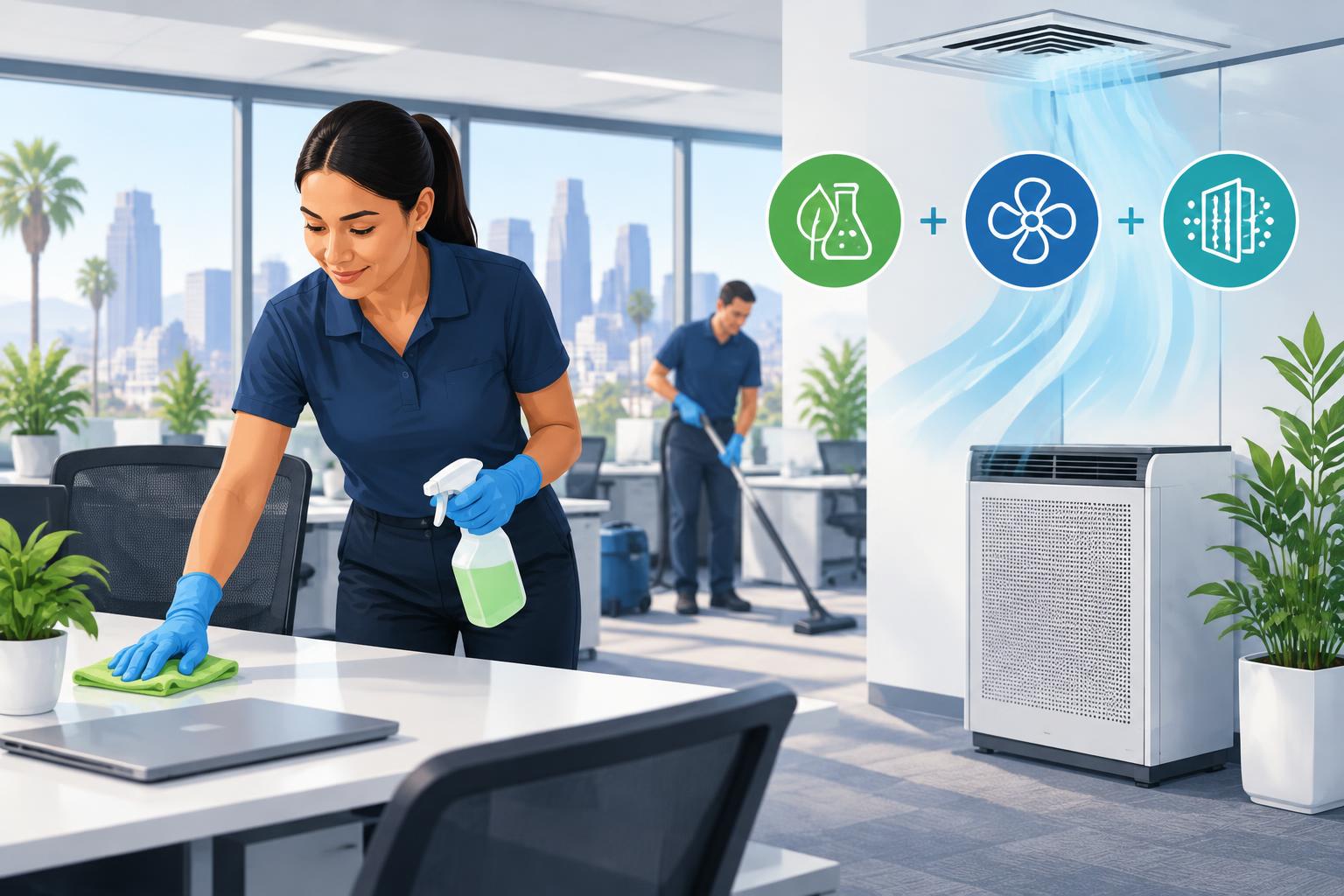
The Air Quality Problem Most LA County Offices Are Ignoring
Most facility managers think about office cleanliness in terms of what they can see—dusty desks, stained carpets, overflowing trash bins. But the more consequential problem is invisible. Indoor air in commercial buildings can carry dust particulates, volatile organic compounds (VOCs) from conventional cleaning products, mold spores, and airborne respiratory viruses. According to the U.S. Environmental Protection Agency, Americans spend roughly 90% of their time indoors—a figure that underscores just how much workplace air quality affects daily health and productivity.
For offices across LA County, where high occupancy densities and older HVAC infrastructure are common, the gap between a clean-looking workspace and a genuinely healthy one can be significant. Bridging that gap requires treating janitorial services as an indoor air quality (IAQ) partnership, not a commodity task.
Why Conventional Cleaning Can Make IAQ Worse
There's an underappreciated irony in standard commercial cleaning: many conventional products introduce their own chemical load into the air. Aerosol disinfectants, solvent-based floor cleaners, and synthetic fragrances can elevate indoor VOC levels immediately after a cleaning session—precisely when staff are returning to their desks.
Switching to Green Seal–certified products addresses this directly. Green Seal's GS-42 standard for commercial and institutional cleaning services evaluates products and practices for reduced toxicity, lower VOC emissions, and responsible ingredient disclosure. For a business operating in a densely built environment like LA County, this isn't a marketing preference—it's a measurable risk-reduction decision.
The practical difference shows up in product selection: microfiber cloths instead of paper towels (which release lint), concentrated low-VOC detergents instead of spray-and-wipe aerosols, and pH-neutral floor care solutions that don't off-gas harsh fumes. These choices reduce the chemical burden on indoor air during and after the cleaning process.
Ventilation and Filtration: The Missing Half of the Equation
Cleaning removes contaminants from surfaces. Ventilation and filtration remove them from the air. Treating these as separate responsibilities is where most office IAQ programs fall short.
The EPA's updated ventilation guidance recommends a layered approach: improving fresh air intake, upgrading HVAC filters (ideally to MERV-13 or higher where equipment allows), and using portable air cleaners in high-traffic zones like conference rooms and reception areas. Running exhaust fans and circulating air during and after cleaning sessions can further reduce the concentration of any residual particles or product vapors. The guidance makes clear that no single measure is sufficient—the goal is stacking complementary strategies.
For a janitorial partner, this means more than showing up with a mop. It means coordinating cleaning schedules with ventilation cycles (for example, running air handlers during and after cleaning, not just during business hours), flagging clogged or deteriorating filters, and avoiding product application in sealed, poorly ventilated spaces.
What to Ask Your Cleaning Provider
Before signing a commercial cleaning contract in LA County, consider asking these questions:
- Do your products carry Green Seal or equivalent third-party certification?
- Will you adjust your schedule to align with our HVAC ventilation cycles?
- Can you flag filter conditions or ventilation concerns during routine visits?
- How do you handle enclosed spaces—server rooms, interior offices—where air exchange is limited?
A provider who can answer these questions with specifics is operating as an IAQ partner. One who can't is offering surface cleaning only.
Deep Cleaning, Post-Construction, and Move-In Scenarios Demand Extra IAQ Attention
Certain cleaning contexts carry a heavier IAQ burden than routine maintenance. Post-construction cleaning in LA County offices, for instance, involves drywall dust, adhesive fumes, and silica particulates that settle into ductwork and on every horizontal surface. Standard janitorial protocols are inadequate here. Effective post-construction cleaning requires HEPA-equipped vacuums, damp-wiping rather than dry-sweeping (which re-suspends particles), and ideally a duct inspection before occupancy.
Similarly, move-in and move-out cleaning scenarios often involve spaces that have been closed up, sometimes for weeks. Stale air, residual odors, and accumulated particulates make ventilation coordination essential—open windows and run HVAC before and during cleaning, not just after. Deep cleaning for heavily used conference rooms or common areas follows the same logic: the goal isn't just visual cleanliness but reducing the microbial and particulate load that accumulates between routine visits.
In each of these scenarios, the cleaning approach directly affects the air quality that the next occupants breathe on day one.
Building an IAQ-First Cleaning Program for Your Office
An IAQ-oriented cleaning program doesn't require a facilities overhaul. It requires aligning three things that are often managed separately: product selection, cleaning protocol, and building ventilation.
Start by auditing current products for VOC content and third-party certification status. Then map your cleaning schedule against your HVAC operating hours—most systems are set to reduce airflow overnight, which is exactly when cleaning crews are working. Adjusting either the schedule or the ventilation timer can meaningfully reduce airborne residues. Finally, establish a communication channel between your cleaning provider and your facilities or property manager so that filter conditions, ventilation issues, and product concerns are flagged proactively rather than discovered during an air quality complaint.
For offices across LA County—from high-rises in Downtown Los Angeles to professional suites in the South Bay—this kind of integrated approach is increasingly what separates compliant facilities from genuinely healthy ones.
Ready to Treat Office Cleaning as an IAQ Investment?
If your current cleaning program focuses on appearance without addressing air quality, it may be leaving a significant health and productivity gap open. LA Cleaning Solutions, LLC provides commercial cleaning and janitorial services across the LA County area with an emphasis on responsible product selection and cleaning practices that support healthier indoor environments. Whether you need routine office cleaning, post-construction cleanup, move-in and move-out services, or deep cleaning for high-traffic spaces, reach out to discuss a program built around your building's actual needs—not just a standard checklist.
About this illustration
This editorial image was created with AI. It is not a photograph of an actual customer, property or completed service.