Office Cleaning & Indoor Air Quality: An IAQ Partnership Guide
Office cleaning in LA County does more than remove visible dirt—it directly affects the air your team breathes. Learn how Green Seal–rated protocols and ventilation-aware scheduling create a true IAQ
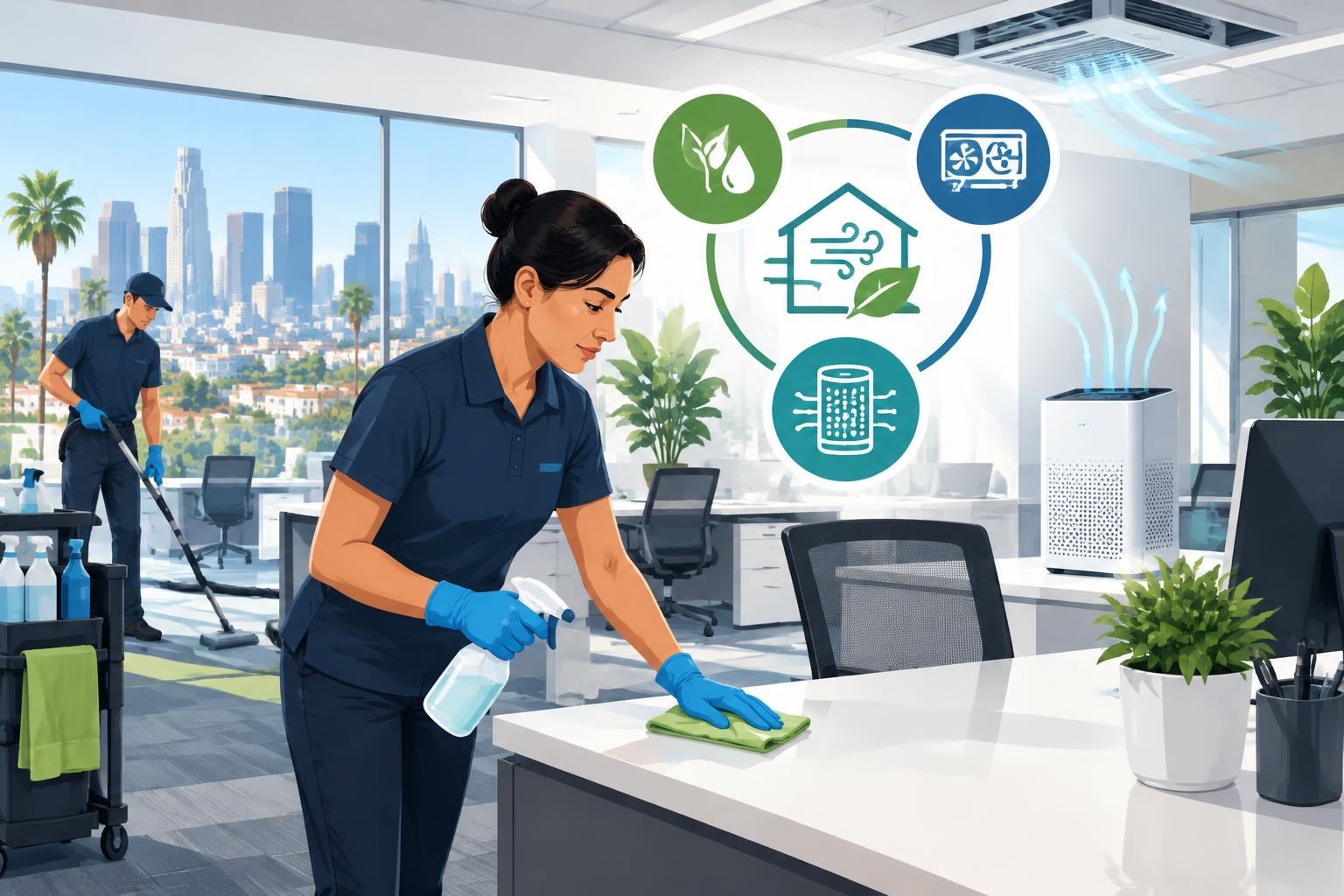
Office Cleaning & Indoor Air Quality: A Smarter Partnership for LA County Workplaces
Most LA County office managers think of cleaning as a visible problem—dusty desks, dirty restrooms, stained carpets. But the air circulating through your workspace tells a different story. Particulate matter, volatile organic compounds (VOCs) from conventional cleaning products, and airborne pathogens accumulate invisibly, affecting employee health and productivity long before anyone notices a dirty floor.
Treating office cleaning as a standalone task misses a critical opportunity. When janitorial protocols are designed to work alongside your building's ventilation system and filtration strategy, cleaning becomes an active investment in Indoor Air Quality (IAQ)—not just a cosmetic reset.
Why IAQ Belongs in Every Commercial Cleaning Conversation
The U.S. Environmental Protection Agency estimates that Americans spend approximately 90% of their time indoors, where pollutant concentrations can be significantly higher than outdoors. The EPA's updated ventilation guidance specifically calls out commercial offices as environments requiring a multi-layered approach to air quality—one that combines filtration improvements, ventilation strategies, and surface-level hygiene practices.
This framing matters for businesses in the LA County area, where dense urban environments and older commercial building stock can compound indoor air challenges. A cleaning service that operates without regard for ventilation timing, product chemistry, or particulate disturbance is working against the very air quality goals your HVAC system is trying to achieve.
The practical takeaway: surface cleaning and air quality are not separate workstreams. They interact constantly, and managing that interaction deliberately is what separates a hygiene vendor from a true IAQ partner.
What Green Seal–Rated Cleaning Protocols Actually Change
Not all "green cleaning" claims carry equal weight. Green Seal's GS-42 standard for commercial and institutional cleaning services establishes concrete requirements that go well beyond product swaps. Certified providers must develop building-specific cleaning plans, follow documented cleaning techniques, maintain sustainable purchasing practices, and train employees to a defined standard—all while communicating transparently with building occupants and management.
Why does this matter for IAQ? Conventional cleaning products are a known source of VOC emissions. GS-42–aligned protocols prioritize products and processes that reduce chemical off-gassing, which directly lowers the concentration of airborne irritants that standard HVAC filters aren't designed to capture. Microfiber cleaning systems, for example, reduce the need for chemical volume while trapping more particulate than traditional cotton mops or cloths.
For office environments with sensitive occupants—employees with respiratory conditions, allergy sensitivities, or proximity to post-construction areas—this distinction is not a marketing preference. It is a measurable health consideration.
Layering Ventilation and Filtration Into the Cleaning Plan
The EPA's updated guidance recommends a multi-layered approach: improve HVAC filtration ratings, introduce portable air cleaners in high-traffic zones, and use fans to support air circulation—particularly during and after cleaning activities. This is where a well-coordinated commercial cleaning service adds value that a cleaning crew working in isolation simply cannot.
Practically, this means scheduling high-disturbance tasks—vacuuming, floor buffing, and restroom deep cleaning—during periods when ventilation can be maximized, such as when HVAC systems are running at full capacity or windows can be opened. It also means flagging to building managers when portable HEPA filtration units would be most beneficial, such as during post-construction cleaning in a renovated suite or after a move-in and move-out cleaning cycle when debris loads are temporarily elevated.
A janitorial partner who understands these dynamics can help you build a cleaning schedule that supports your ventilation strategy rather than working against it. That coordination is especially relevant in the LA County area, where many commercial buildings operate with legacy HVAC systems that benefit most from the kind of surface-level particulate reduction that disciplined cleaning protocols provide.
High-Impact Zones That Drive IAQ Risk
Not all areas of an office contribute equally to indoor air quality problems. Three zones deserve particular attention:
Carpeted Common Areas and Workstations
Carpets act as reservoirs for particulate matter, allergens, and biological debris. Without a consistent, technique-driven vacuuming protocol—ideally using HEPA-filtered equipment—routine foot traffic re-suspends these particles into breathing zones. High-frequency vacuuming using enclosed filtration systems is one of the highest-leverage IAQ interventions available to any office cleaning program.
Restrooms and Break Rooms
These spaces generate both biological aerosols and chemical off-gassing from conventional disinfectants. GS-42–aligned product selection and proper dwell-time protocols reduce both risks while maintaining effective disinfection outcomes.
Recently Renovated or Transitional Spaces
Post-construction cleaning in LA County commercial spaces presents a concentrated IAQ challenge: fine construction dust, adhesive fumes, and disturbed insulation materials can linger in HVAC ducts and on surfaces for weeks after work crews leave. A thorough, sequenced cleaning approach—working from high surfaces downward, using HEPA vacuums before any wet cleaning, and coordinating with HVAC filter replacement—makes a measurable difference in how quickly a space becomes occupant-ready.
Building an IAQ-First Cleaning Partnership for Your Office
Shifting from transactional cleaning to an IAQ partnership requires a few deliberate decisions. First, ask prospective janitorial services providers whether their protocols align with recognized standards such as Green Seal GS-42, and what that alignment looks like in practice—not just on paper. Second, share your HVAC schedule and any known building air quality concerns upfront; a serious commercial cleaning provider will factor that information into their approach.
Third, revisit cleaning frequency and scope when your building's occupancy or use changes. A suite that recently completed construction, a floor undergoing move-in and move-out activity, or a workspace that has expanded its headcount all present changed IAQ conditions that a static cleaning contract won't automatically address.
For businesses across the LA County area, the combination of urban air quality pressures, dense occupancy, and varied building stock makes this kind of proactive thinking especially worthwhile. Office cleaning done right isn't just about appearances—it's about the air your team breathes every day.
Ready to Make Your Workspace Healthier?
If you're evaluating commercial cleaning or janitorial services in the LA County area and want a provider who understands how surface cleaning connects to the air quality in your building, reach out to LA Cleaning Solutions, LLC. Their team offers commercial cleaning, janitorial services, and residential cleaning designed around the specific needs of your space. Contact them directly to discuss a cleaning plan that works with your ventilation strategy—not around it.
About this illustration
This editorial image was created with AI. It is not a photograph of an actual customer, property or completed service.