Office Cleaning & Indoor Air Quality in LA County
Indoor air quality in LA County offices is directly shaped by how — and with what — a building gets cleaned. Learn how Green Seal–rated products, HVAC coordination, and filtration upgrades reduce VOCs
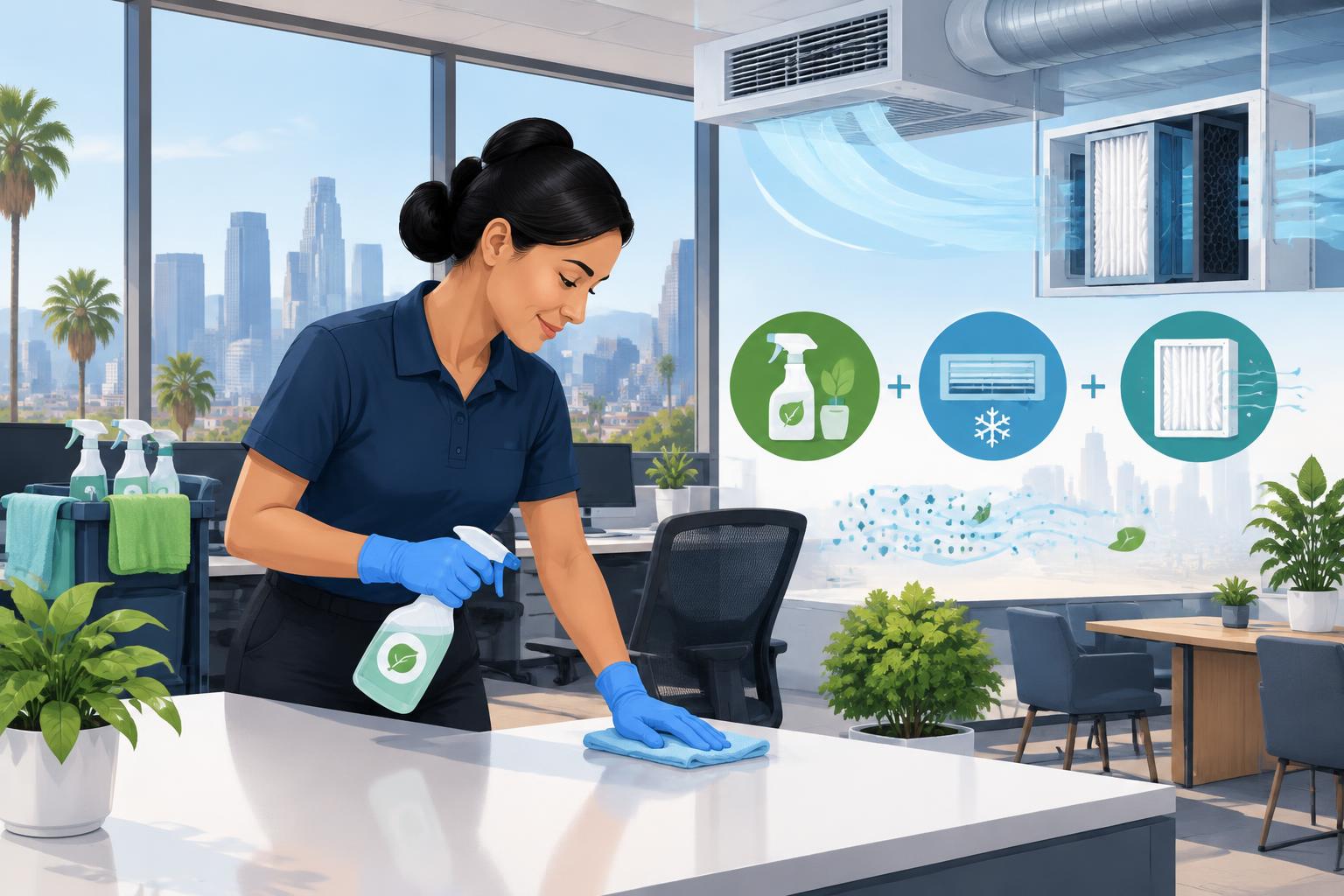
Most LA County office managers think of cleaning as a visible outcome — spotless floors, empty trash bins, wiped-down desks. What's harder to see is what lingers in the air long after the cleaning crew leaves: volatile organic compounds (VOCs) from conventional cleaning products, fine particulates stirred up by dry dusting, and bioaerosols cycling through poorly maintained HVAC systems. Those invisible byproducts are a real occupational health concern, and the way a building gets cleaned is either part of the problem or part of the solution.
According to the U.S. EPA, people spend roughly 90 percent of their time indoors, and indoor pollutant levels are often several times higher than outdoor levels. For a busy commercial office, that statistic carries direct implications for employee health, productivity, and long-term building maintenance costs.
Why IAQ Belongs in Your Cleaning Conversation
Indoor air quality (IAQ) refers to the characteristics of air inside buildings that affect health, comfort, and performance. The EPA's IAQ factsheet identifies several controllable factors: consumer products and building materials, temperature and humidity, and — critically — how building systems like HVAC are maintained.
Cleaning activities touch nearly every one of those factors. The products used introduce or remove chemical load. The methods used (dry sweeping vs. damp mopping, backpack vacuums with HEPA filtration vs. standard uprights) determine how much particulate matter gets resuspended into breathing zones. A janitorial program that ignores IAQ can actively degrade the air it's supposed to help maintain.
This isn't a niche concern for LEED-certified buildings only. Any commercial office in LA County — from a mid-rise in Century City to a professional suite in Pasadena — is subject to the same basic physics of pollutant accumulation indoors.
The Case for Green Seal–Rated Cleaning Products
Not all "green" or "eco-friendly" labels carry equal weight. Green Seal is an independent nonprofit that certifies products and services against rigorous, science-based environmental standards. Its GS-42 standard covers commercial and institutional cleaning services, addressing chemical hazards, dilution control, and packaging — giving facility managers a credible benchmark rather than a marketing claim.
In practical terms, specifying Green Seal–certified products in a janitorial contract means the cleaning solutions entering your office have been evaluated for VOC content, ingredient toxicity, and packaging waste. Conventional multi-surface sprays and floor finishes can off-gas measurable VOC levels, particularly in spaces with limited ventilation. Switching to certified low-VOC alternatives is one of the most direct ways to reduce the chemical load on your building's air.
For office cleaning in LA County, where smog and outdoor air quality already pressure building air systems, reducing indoor VOC sources is especially worth prioritizing. It's a straightforward product substitution with compounding benefits for occupant comfort and compliance with California's increasingly stringent indoor environment expectations.
HVAC Coordination: The Link Most Cleaning Programs Miss
Cleaning and HVAC maintenance are usually handled by separate vendors on separate schedules — and that disconnect is where IAQ problems often take hold. Dust and debris dislodged during cleaning can be pulled directly into return air vents if the HVAC system is running during service. Conversely, a cleaning program that ignores duct grilles, diffusers, and filter access panels leaves a major particulate reservoir untouched.
Effective commercial cleaning should be sequenced around HVAC operation. High-dusting and carpet work, for example, are better performed when systems are off or in recirculation mode, with adequate time for particles to settle before the system resumes distributing air throughout the space. This kind of coordination requires communication between the janitorial team and the building's facilities manager — something a capable commercial cleaning provider should be prepared to facilitate.
It's also worth noting the EPA's guidance that improved ventilation — bringing in fresh air to dilute and exhaust indoor pollutants — is a core IAQ best practice. A cleaning program that inadvertently loads the HVAC system with particulates works against that goal; one that coordinates with it reinforces it.
Filtration Upgrades Worth Discussing with Your Cleaning Provider
HVAC filter selection directly affects how much fine particulate matter circulates through occupied spaces. Standard filters (typically MERV 8 or below) capture larger particles but allow finer PM2.5-range particulates and some biological aerosols to pass through. Upgrading to MERV 13 filters — recommended by the EPA for commercial settings where occupant health is a priority — meaningfully reduces the fine particle load cycling through the system.
A knowledgeable janitorial services provider won't install filters themselves, but they should be able to flag when filters are visibly overloaded, note conditions that suggest filtration is inadequate (persistent dust resettlement between cleanings, for example), and coordinate with your facilities team on inspection timing. That advisory role is part of what separates a genuine IAQ-aware cleaning program from a standard mop-and-go contract.
Portable HEPA air filtration units in high-traffic areas — conference rooms, reception areas, break rooms — can also supplement central HVAC filtration during and after cleaning. These are practical, low-cost additions that noticeably reduce particulate load in zones where occupant density is highest.
Building a Cleaner, Healthier Office in LA County
The good news is that improving IAQ through smarter commercial cleaning is achievable without a major capital project. The core levers — certified low-VOC products, HEPA-equipped equipment, HVAC-coordinated scheduling, and regular filter monitoring — are operational decisions, not infrastructure ones. They require a cleaning partner who understands the relationship between cleaning practice and air quality outcomes, not just one who shows up with a mop.
For offices across LA County, these practices also align with a broader workforce expectation: employees increasingly notice and respond to the physical environment they work in. A cleaner, better-ventilated office is not just a health asset — it's a retention and productivity asset.
Ready to upgrade your office's air quality through smarter cleaning practices? LA Cleaning Solutions, LLC serves commercial and residential clients throughout the LA County area, providing janitorial services, commercial cleaning, and deep cleaning programs built around real IAQ outcomes. Reach out today to discuss a cleaning plan tailored to your building's specific needs.
About this illustration
This editorial image was created with AI. It is not a photograph of an actual customer, property or completed service.