Green Cleaning & Indoor Air Quality for LA County Offices
Green cleaning practices directly impact indoor air quality in LA County offices and commercial spaces. Learn how low-VOC products, HEPA equipment, and HVAC coordination create healthier workplaces.
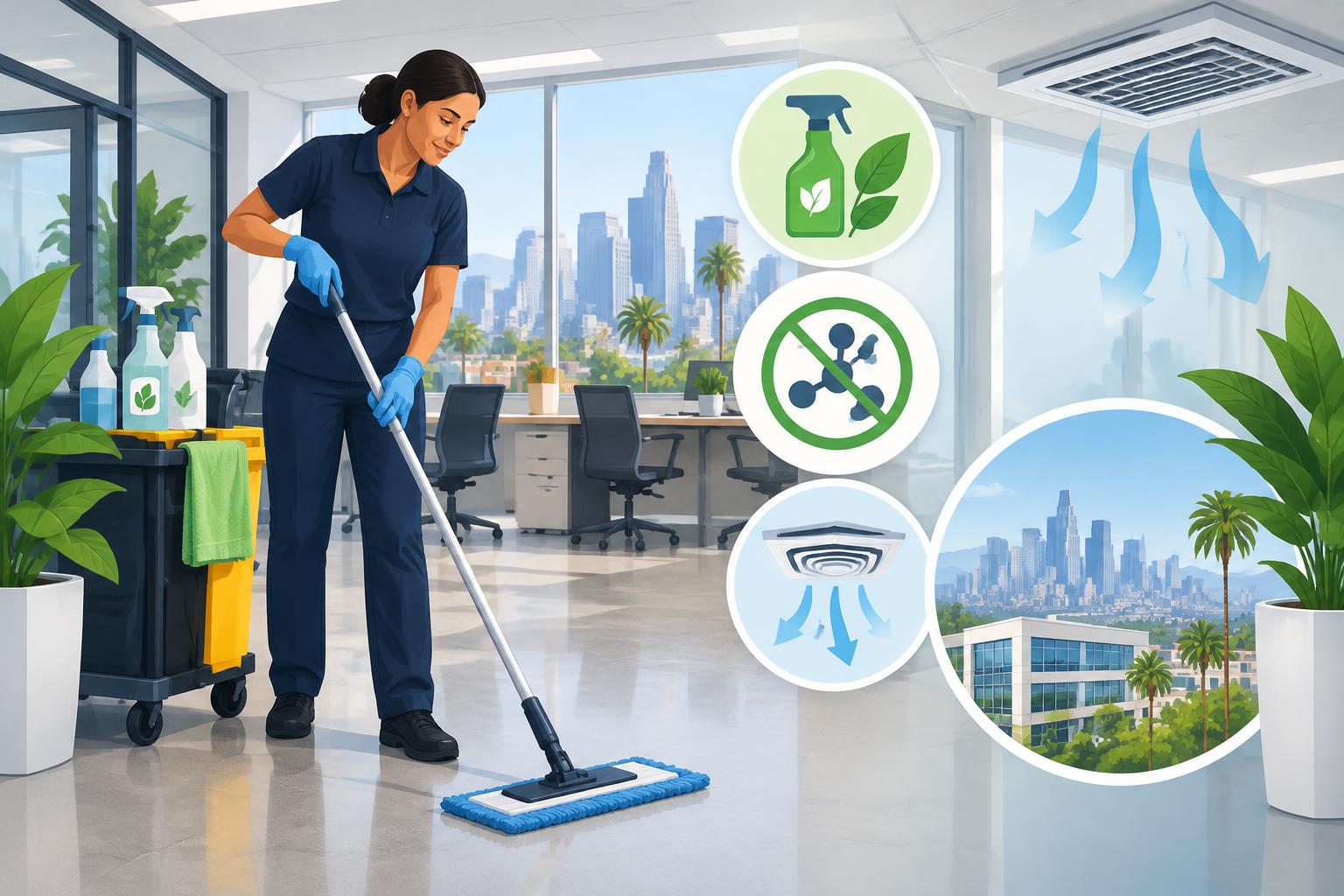
When people think about a clean workplace, they usually picture spotless floors, empty trash bins, and streak-free windows. But there is another dimension to workplace cleanliness that is just as important — the air your employees and visitors breathe every day. For businesses across the LA County area, understanding the relationship between janitorial practices and indoor air quality (IAQ) is a smart investment in both health and productivity.
What Is Indoor Air Quality and Why Does It Matter?
Indoor air quality refers to the condition of the air inside a building, particularly as it affects the health and comfort of occupants. Commercial spaces — offices, retail locations, medical suites, and warehouses — can trap pollutants at levels that significantly exceed outdoor air, largely because modern buildings are tightly sealed for energy efficiency.
Common indoor air pollutants include dust, mold spores, chemical vapors from cleaning agents, and particulate matter stirred up by daily foot traffic. Poorly managed IAQ has been linked to headaches, fatigue, respiratory irritation, and reduced cognitive performance — conditions sometimes grouped under the term "sick building syndrome."
The U.S. Environmental Protection Agency and the National Institute for Occupational Safety and Health have long recognized this challenge. Their Building Air Quality (BAQ) Guide provides building owners and facility managers with practical strategies for preventing, identifying, and resolving IAQ problems in public and commercial buildings — and cleaning practices are a central part of that framework.
How Conventional Cleaning Products Affect Air Quality
Not all cleaning products are created equal. Many conventional janitorial chemicals contain volatile organic compounds (VOCs) — substances that evaporate at room temperature and linger in the air long after a surface has been wiped down. Common VOC sources in cleaning include aerosol sprays, solvent-based degreasers, synthetic air fresheners, and certain disinfectants.
In a typical office environment, VOC buildup can accumulate throughout the day, especially in spaces with limited ventilation. For occupants who spend eight or more hours indoors, repeated low-level exposure adds up over time.
Switching to low-VOC or VOC-free cleaning formulations is one of the most direct ways commercial cleaning services can improve the breathing environment of a workspace. Green-certified products — those that meet recognized third-party environmental standards — are designed to deliver effective cleaning performance while minimizing the release of harmful chemical vapors. This is a cornerstone of what is broadly called "green cleaning."
Green Cleaning: Safer Products and Smarter Practices
Green cleaning is not simply about using eco-friendly bottles. It encompasses the full set of practices, tools, and products that reduce chemical exposure, minimize waste, and protect both building occupants and the cleaning staff themselves.
According to the CDC's NIOSH guidance on cleaning and custodial services, custodial workers face real occupational health risks from handling chemical cleaning agents, including skin diseases, allergies, and respiratory conditions. Adopting greener product lines and safer handling protocols benefits workers as much as it benefits building occupants.
Key elements of a green cleaning approach for commercial spaces include:
- Low-VOC, biodegradable cleaning solutions that break down safely without releasing harmful vapors
- Microfiber cloths and mop heads that capture more dust and bacteria with less chemical product
- HEPA-filter vacuums that trap fine particulate matter rather than recirculating it into the air
- Dilution control systems that reduce chemical waste and the risk of over-application
- Fragrance-free or low-fragrance formulas to reduce irritation for employees with asthma or chemical sensitivities
For office cleaning in the LA County area, green cleaning practices are increasingly expected — not just by environmentally conscious tenants, but by building managers seeking to maintain healthy, high-performing spaces.
HVAC Coordination: The Hidden Link to IAQ
Even the best green cleaning program can fall short if it is not coordinated with a building's heating, ventilation, and air conditioning (HVAC) system. HVAC systems are the lungs of a commercial building — they circulate, filter, and condition the air throughout every occupied space. When cleaning activities disturb dust, release chemical vapors, or introduce moisture, the HVAC system either helps remove those contaminants or inadvertently distributes them.
The EPA's Building Air Quality Guide specifically highlights HVAC system design and operation as a critical factor in IAQ management. Scheduling certain cleaning tasks — such as carpet deep cleaning, stripping and refinishing hard floors, or heavy degreasing — during off-hours when HVAC systems can run in full exhaust or flush mode helps clear airborne residues before employees return the next morning.
Facility managers and commercial cleaning providers should communicate openly about:
- Cleaning schedules relative to HVAC cycles — particularly for after-hours commercial cleaning
- Filter replacement timing — heavy cleaning activity generates more particulate, which can clog filters faster
- Moisture management — wet cleaning methods in poorly ventilated areas can raise humidity and encourage mold growth
- Product selection sign-off — ensuring that cleaning chemicals used in sensitive areas (server rooms, medical offices, food preparation zones) are approved and compatible with HVAC intake locations
This kind of coordination between janitorial services and building infrastructure is what separates a surface-level clean from a genuinely healthy building environment.
Applying These Principles: From Deep Cleaning to Day-to-Day Maintenance
Green cleaning and IAQ best practices are not limited to any single service type. They apply across the full spectrum of commercial janitorial work — from routine nightly office cleaning to specialized projects.
Deep cleaning and post-construction cleaning in the LA County area, for example, involve the removal of drywall dust, adhesive residues, and construction-related particulates that can be especially damaging to IAQ if not handled with the right equipment and products. HEPA vacuuming, sealed-off work zones, and careful HVAC coordination are all critical in these scenarios.
Move-in and move-out cleaning presents its own IAQ considerations, especially when transitioning between tenants in commercial spaces. Residual chemical odors, accumulated biological contaminants, and disturbed settled dust all require targeted, ventilation-aware cleaning protocols to ensure the space is genuinely healthy for the next occupant — not just visually clean.
Even routine floor care — mopping, buffing, and refinishing — carries IAQ implications. Floor finish strippers and sealers are among the higher-VOC products used in commercial janitorial work. Choosing low-VOC floor care chemistry and ensuring adequate ventilation during application protects both workers and future occupants.
Take the Next Step Toward a Healthier Workspace
If your business operates in the LA County area and you want a cleaning partner who understands that cleanliness goes beyond what the eye can see, LA Cleaning Solutions, LLC is ready to help. Whether you need consistent commercial cleaning, a one-time deep clean, or specialized services tailored to your building's IAQ needs, the right approach starts with a conversation.
Reach out today to discuss how a green cleaning program can improve the air quality, comfort, and safety of your workplace — for your employees, your clients, and your bottom line.
About this illustration
This editorial image was created with AI. It is not a photograph of an actual customer, property or completed service.